Early Human Use of Biofuels
Burning Wood and Plant Matter in Ancient Civilizations
Around 1.5 million years ago, our ancestors first tamed fire, marking a pivotal shift in human existence. This mastery of combustion was the true beginning of our relationship with biofuels. Early hominins did not conceptualize fuel as a commodity; they perceived wood and dry plant matter as immediate tools for warmth, protection, and cooking. Their discovery was not a moment of scientific insight, but a gradual realization of utility, passed down through generations of observation and necessity. This pragmatic use of biomass to generate heat is the foundational answer to the question of who discovered biofuels, as it was a collective, prehistoric revelation.
In ancient civilizations, this practice evolved from a survival tactic into a managed resource. The Romans, for instance, constructed vast networks of villas with underfloor heating systems, called hypocausts, that demanded enormous quantities of wood. Similarly, early agricultural societies in the Nile Valley utilized crop residues, such as straw and dried reeds, as a primary cooking fuel. These cultures understood the calorific value of different plant materials, selecting dense hardwoods for forge fires and lighter scrub for domestic ovens. This period saw the first instances of fuel logistics, with supply chains emerging to transport timber from distant forests to urban centers.
The shift toward systematic cultivation of fuel sources demonstrates a deep psychological shift in our species. We began to manage our environment not just for food, but for energy security.
– Coppicing, the practice of cutting tree stems to ground level to encourage new growth, was used in Europe to create a sustainable wood supply.
– Olive pits and nut shells were collected and stored, recognizing their high energy density for use in lamps and kilns.
– Animal dung was dried and stacked, becoming a vital fuel source in regions where trees were scarce.
These actions were the first steps toward energy management. They reflect a human impulse to secure our future against the cold and the dark, a drive that persists in our modern energy policies. The recognition that certain materials burn longer or hotter was empirical, born of trial and error, and it set the stage for millennia of innovation. The true discoverers, therefore, were the countless anonymous people who learned to read the landscape for its combustible potential, turning the natural world into a source of controllable power.
The Discovery of Biogas in Ancient China
While other civilizations burned wood directly, ancient China took a different path. By 200 BCE, Chinese engineers captured biogas from sealed cesspits filled with animal waste and rotting plant matter. They piped this flammable gas through bamboo tubes to evaporate brine for salt production, an application that predates modern biogas plants by over two thousand years.
The question of who discovered biofuels has no single answer, but the Chinese contribution remains remarkable. They transformed decomposition into a controllable energy source. Leftover sludge became fertilizer, closing a practical loop of waste and fuel. This was not an accident; it was systematic experimentation. The Chinese recognized that even decay could yield power, proving that bioenergy innovation is far older than our industrial age.
Learned Scholars Documenting Oil from Plants
Around 300 BCE, the Greek scholar Theophrastus produced one of the earliest written catalogues of oil-bearing plants. He recorded how pressing certain seeds and fruits produced flammable liquids suitable for lamps. This documentation moved biofuel knowledge from trial and error into recorded science.
The question of who discovered biofuels grows complicated here. No single person invented the process. The scholars who wrote it down shaped how later cultures understood plant energy. Their records preserved details that might otherwise have vanished.
Classical texts mention three fuel oils:
- Olive oil from the Mediterranean basin, burned in clay lamps for home light
- Castor oil, used in Egyptian lamps and prized for its steady flame
- Sesame oil, documented in Asian records for both cooking and illumination
These entries were deliberate comparisons of burn time, flame quality, and availability. Those scholars gave us the earliest comparative studies of biofuel sources. Ask who discovered biofuels and the answer credits these early documenters as much as any experimenter.
Chemical Foundations Laid by Enlightenment Science
The Work of Joseph Priestley on Gases
Joseph Priestley never held a flask of biodiesel, but his 1770s experiments with gases changed chemistry forever! When he isolated oxygen and other gaseous compounds, he supplied later scientists with the means to interpret what burning plant matter truly releases. The question of who discovered biofuels begins with Priestley’s glassware, his captured bubbles, and his methodical notes.
- Oxygen, for combustion studies
- Nitrous air, later named nitric oxide
- Inflammable air, which we call hydrogen
These were not biofuels themselves. They were the building blocks of chemical knowledge. Without his techniques, the methane rising from decayed biomass might have remained a mere curiosity. So when we ask who discovered biofuels, we must pause at Priestley’s bench and acknowledge the quiet power of a well-collected gas.
Antoine Lavoisier and the Chemistry of Fermentation
Lavoisier brought a scale to chemistry. His 1789 experiments on fermentation showed that sugar splits into alcohol and carbon dioxide. That reaction remains the foundation of ethanol fuel production today. When we ask who discovered biofuels, Lavoisier’s laboratory deserves a place in the answer. He proved that plant material can transform into energy-rich liquids, and he could demonstrate it with precise weights.
Fermentation chemistry handed future generations their oldest fuel recipe. Lavoisier recorded the essential actions:
- Weighing every reactant and product
- Identifying carbon dioxide as a distinct gas
- Showing that alcohol forms from sugar breakdown
Those observations turned a folk practice into a science. He never built a fuel engine, but he connected biomass to chemical transformation. That connection made the search for who discovered biofuels a matter of chemistry, not accident.
The First Isolation of Ethanol by Abū Mūsā Jābir ibn Hayyān
Long before the first engine shuddered to life, an eighth century alchemist named Abū Mūsā Jābir ibn Hayyān coaxed pure ethanol from fermented wine. His distillation apparatus turned a murky brew into a clear, burning spirit. That spirit would eventually power machines, but for centuries it remained a curiosity.
Jabir’s method was not folklore. It required precise attention to heat, vapour, and condensation. He documented the process so carefully that later scholars could repeat it. To ask who discovered biofuels is to recognise that chemistry, not accident, gave us liquid energy. Enlightenment scientists later refined his work. They measured, named, and theorised. Yet the foundation stood. The isolation of ethanol was the first deliberate step from plant matter to fuel.
Jabir’s legacy includes:
- The first reliable distillation of ethanol.
- A written record that survived centuries.
- A bridge between alchemy and modern chemistry.
Without that bridge, the question of who discovered biofuels might have no answer.
Nicholas Jacobson’s Early Ethanol Studies
Eighteenth century chemists turned the question into a matter of measurable evidence. Nicholas Jacobson embodied that shift. His early ethanol studies favoured repeatable process over grand claims.
Jacobson tracked fermentation temperature, vapor density, and condensation rates. He found that slow heating separated ethanol from fusel oils with remarkable clarity. That demanded patience and precision!
His findings included:
- A precise relationship between boiling point and ethanol concentration.
- A chart of vapor compositions that later distillers relied upon.
These details made ethanol a laboratory substance, not a curiosity. When we trace the lineage of biofuel research, Jacobson’s patient measurements are essential. The answer to who discovered biofuels must acknowledge such foundational chemistry, even if the names remain obscure.
Industrial Era Innovators and Inventors
Samuel Morey’s 1826 Ethanol Engine
In the shadow of the Industrial Era, a quieter revolution simmered. While steam engines thundered, Samuel Morey, an American inventor, harnessed a different kind of power in 1826. He built an engine that ran on ethanol, a fuel distilled from plant matter. This wasn’t a laboratory curiosity; it was a working prototype that predated the modern internal combustion engine by decades.
Morey’s creation was a fascinating hybrid. It combined elements of a steam engine with a gas engine, using a mixture of ethanol and turpentine to ignite a controlled explosion. The force of that explosion drove the piston. His patent for this “gas or vapor engine” was granted, and the design was surprisingly advanced for its time.
The specifications of Morey’s engine were notable:
- It was one of the first to use a liquid fuel.
- The design included a carburetor to mix fuel and air.
- It featured electric ignition, a concept far ahead of its era.
Despite the ingenuity, Morey’s engine never achieved commercial success. Funding was scarce, and the age of petroleum was dawning. Yet, his work is a pivotal answer for anyone asking who discovered biofuels. He proved that liquid fuel from plants could power machinery, setting a precedent that would echo into the next century. His engine was a ghost of the future, a machine that showed a path few were ready to take.
Nikolaus Otto and the Internal Combustion Engine
The story of who discovered biofuels often collides with the deafening rise of the internal combustion engine. Nikolaus Otto did not ask the question of what fuel could be. He asked how to make the explosion more efficient. In 1876, he patented the four stroke cycle, a design that still powers our world. This was a shift from Morey’s quiet, plant powered ghost to a machine demanding consistency. Otto’s engine did not care where the energy came from, only that it was volatile. Petroleum was simply the most convenient answer.
Otto’s genius was in the mechanics of control. He solved the problem of a combustible mixture igniting at the wrong time. The compressed charge, the precise spark, the exhausting of burnt gases. It was a symphony of timing. His work effectively ignored the biological origins of fuel. For him, the liquid was a tool. Yet, this very focus created a dependency. The engine’s design dictated the fuel’s properties, and biofuel had to adapt to his machine, not the other way around. This development is crucial for anyone exploring who discovered biofuels, because it shows the path not taken.
His key innovations included:
1. The four stroke operating cycle, which separated intake, compression, power, and exhaust.
2. A practical carburetor design that stabilized the fuel air mixture.
3. The use of a flame or hot tube ignition system, later improved with electrical spark.
4. A focus on stationary engines for industrial power, which made the technology commercially viable.
The psychological shift here is profound. Morey’s engine was an individual act of creation. Otto’s engine was an industrial statement. The biofuel question became secondary to the machinery. The infrastructure for oil was built around this engine’s requirements. The human preference for power and convenience overshadowed the potential of renewable plant sources. Otto’s success did not disprove biofuels; he simply made them less relevant to a world hungry for immediate, dense energy.
Rudolf Diesel’s Vision for Vegetable Oils
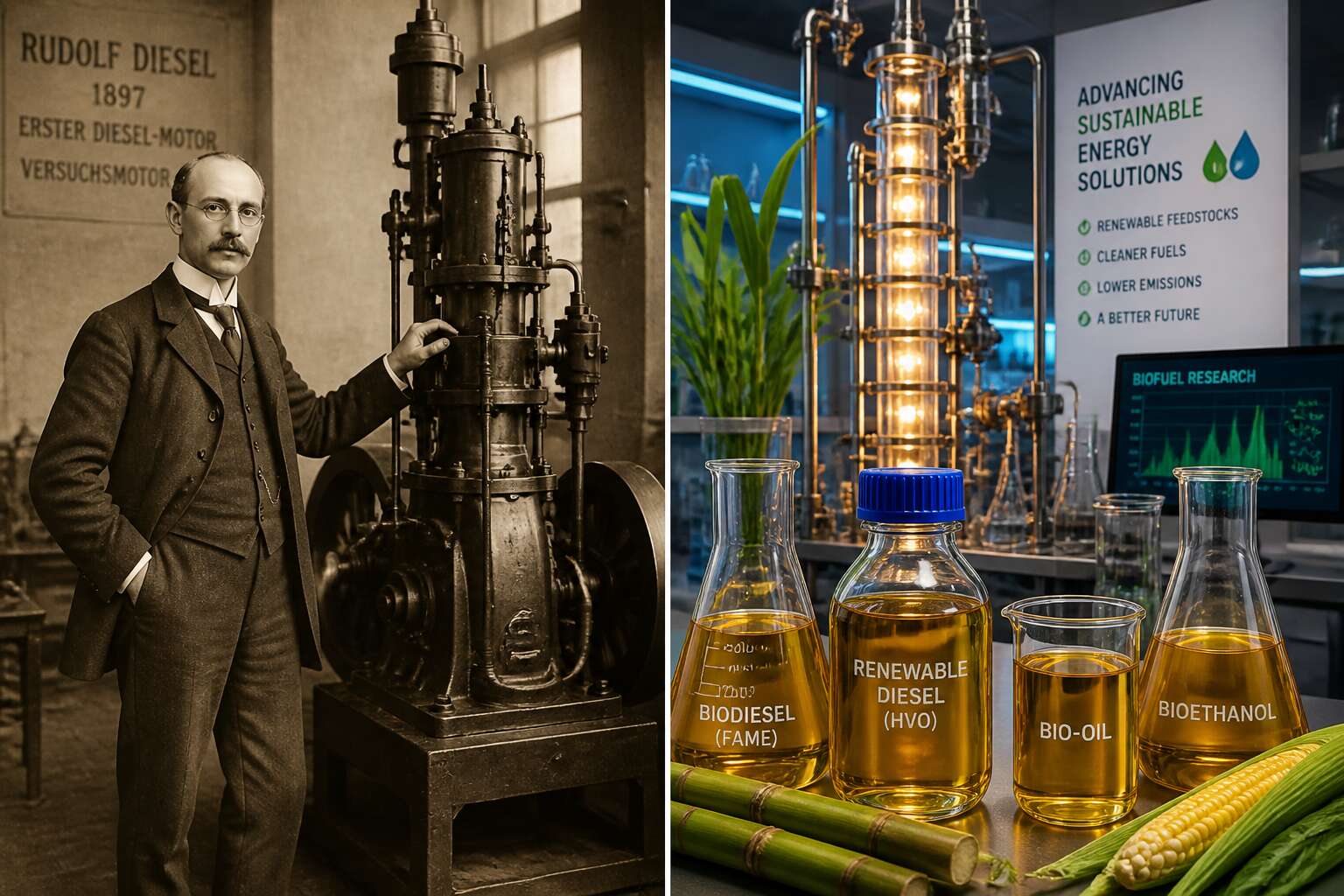
Rudolf Diesel built his engine in 1893. He saw the future in plants. His machine could run on peanut oil. The question of who discovered biofuels finds an answer in his notebooks. Diesel did not invent biofuel, but he proved its industrial viability. He designed for compression, not spark. Heat ignited the fuel. Vegetable oil tolerated this pressure.
Diesel died in 1913, a mystery. His body vanished from a steamer. His ideas vanished too. Petroleum won.
- His 1912 essay predicted vegetable oils would replace petroleum.
- He demonstrated an engine on peanut oil at the 1900 World’s Fair.
These facts remain archival. Diesel’s dream was buried. The search for who discovered biofuels continues through his ghost.
Henry Ford and the Model T Flex-Fuel
Henry Ford had his own ghost to chase. While Diesel’s notebooks gathered dust, Ford was selling America a machine that could drink from the same botanical well. The Model T, introduced in 1908, was a flex fuel vehicle from the very start.
It ran on ethanol, gasoline, or a combination of the two. Ford believed in the countryside. He wanted farmers to fuel the nation, not oil barons. He once said alcohol was the fuel of the future. His carburetor design included an adjustable needle valve, letting drivers switch between fuels with a simple turn.
The irony is thick enough to taste. Petroleum prices crashed. Ethanol could not compete with the cheap, abundant crude discovered in Texas and Oklahoma. The adjustable valve stayed, but the ethanol never came.
Biographies of Ford note his frustration. He watched the petroleum industry consolidate power, decade after decade. Even his partnership with Standard Oil could not revive his vegetable fuel dream. The question of who discovered biofuels gains another layer here. Ford did not dig up the science. He industrialised the possibility. He built fifteen million cars that could have run on renewable energy had the economics cooperated. The history of biofuel is a graveyard of good ideas, and Ford is one of its most prominent residents.
The Contributions of Étienne Lenoir
Étienne Lenoir never paused to ask who discovered biofuels. He was too busy coaxing his engines to run at all. In 1860, Lenoir patented the first commercially successful internal combustion engine, a machine that burned coal gas. It was inefficient, greasy, and loud, but it worked without steam. Lenoir did not use ethanol or vegetable oil. He relied on manufactured gas, a fossil product. His engine still shifted the technical landscape. It proved that controlled combustion could drive a piston without a boiler. That proof gave Diesel and Otto a practical starting point for their own experiments.
– Lenoir’s engine ran on coal gas, not plant fuel
– His electric spark ignition influenced later designs
– He never considered renewable alternatives
So when historians map the biofuel story, Lenoir appears as the builder of the machine, not the fuel. The question of who discovered biofuels belongs to a different lineage entirely.
Twentieth Century Biofuel Discoveries
Charles F. Kettering and High-Octane Ethanol
Charles F. Kettering, the General Motors engineer with a flair for provocation, spent the 1920s chasing a question that still vexes historians: who discovered biofuels as a practical fuel? He did not find a single name, but he did find ethanol’s octane-boosting properties.
Kettering’s engines knocked! He discovered that ethanol added to petrol prevented that knock, raising compression ratios. This high-octane ethanol offered a performance advantage that petroleum alone could not match.
- Ethanol raised compression without engine damage
- It burned cleaner than leaded petrol alternatives
- Kettering initially championed its use
His crusade faded when cheaper tetraethyl lead arrived, a decision with consequences we still measure. The honest answer acknowledges Kettering’s laboratory as one critical site, though not the origin point.
The Development of Biodiesel by E. Duffy and Others
E. Duffy’s name rarely appears in fuel history. His 1853 transesterification experiments proved that vegetable oils could be chemically converted into a combustible liquid, yet the discovery sat dormant for decades.
The twentieth century changed that. In the 1930s, Belgian engineers extended Duffy’s work and patented processes for palm oil ethyl ester, an early biodiesel. The fuel performed in existing diesel engines without modification.
- It required no engine modification
- It burned with lower particulate emissions
- It relied on renewable feedstocks
South African farmers experimented with sunflower oil biodiesel during fuel shortages. Their results mirrored global progress. The question of who discovered biofuels gains nuance with every chapter. Duffy supplied the chemistry. Engineers supplied the scale. Farmers supplied the proof.
Biofuel Research in World War II
World War II turned biofuel research into logistics. Germany, starved of petroleum imports, powered military vehicles with synthetic fuels from coal and agricultural residue. Japan launched pine root oil extraction programs, feeding resinous oil into aircraft tanks. South African research stations revived sunflower oil experiments for domestic supply.
The wartime record documents specific applications:
- German columns ran on coal-derived synthetic fuels
- Japanese aircraft burned pine root oil blends
- Allied field units tested vegetable oil in diesel generators
Tracing these programs, I found teams in different countries solving identical problems in isolation, unaware of parallel work. The question of who discovered biofuels has no single answer. The fuel emerged from wartime pressure, not individual genius.
The Oil Crisis of the 1970s and Modern Biofuel Programs
When OPEC halted oil exports in 1973, fuel queues stretched around Johannesburg filling stations. The crisis transformed biofuel research from wartime curiosity into peacetime policy. Brazil launched the ProAlcool programme, pushing sugarcane ethanol into millions of cars. The United States followed with corn based ethanol subsidies. Neither programme answered who discovered biofuels, because the question had shifted from individual credit to national strategy.
Modern biofuel programmes rely on coordinated systems rather than lone inventors:
- Feedstock genetics, from drought resistant maize to high yield oil palms
- Conversion technologies such as enzymatic hydrolysis and transesterification
- Distribution networks that blend ethanol or biodiesel into conventional fuel
South Africa’s biodiesel industry now draws on sunflower and canola oils, reviving earlier experiments with fresh urgency.
The Discovery of Enzyme-Based Biofuel Production
The search for who discovered biofuels becomes strange when enzymes enter the story. In the early twentieth century, biochemists isolated cellulase enzymes that dismantle plant fibres into fermentable sugars. These enzymes replaced corrosive acids in breaking down wood and agricultural residue. This shift allowed ethanol production from lignocellulose biomass, a vast and previously untapped feedstock. A 1920s researcher could watch sawdust dissolve into a sugar solution, a quiet transformation in a laboratory beaker.
Enzymatic hydrolysis also reshaped biodiesel. Lipase enzymes chop triglycerides from sunflower or canola oil into methyl esters. The reaction proceeds at room temperature. It needs no caustic catalyst, which lowered production costs.
Key twentieth century processes included:
- Saccharification of maize stover with fungal enzymes
- Transesterification of waste oils with immobilised lipases
- Pretreatment of bagasse with engineered cellulases
South African researchers now adapt these enzymes for cottonseed and yellow grease feedstocks.
Pioneers in Algae Biofuel Research
Algae biofuel research has its own answer to the question of who discovered biofuels. In the 1950s, the Carnegie Institution showed that Chlorella vulgaris could accumulate lipids under stress conditions. This single finding reoriented biofuel science from terrestrial plants to microscopic organisms.
Pioneers like Oswald and Golueke proposed open pond systems for methane production in 1960. The American Aquatic Species Program later screened thousands of microalgae strains, including the hydrocarbon rich Botryococcus braunii. That program spanned two decades and produced foundational knowledge on lipid extraction and cultivation.
- Oswald and Golueke designed high rate algal ponds for wastewater treatment and methane.
- The 1980s Japanese Green Energy Program explored marine microalgae cultivation.
- South African researchers now test local strains of Scenedesmus and Nannochloropsis in raceway ponds.
The search for who discovered biofuels continues, but these twentieth century pioneers established the core science that every modern algae facility builds upon.
Contemporary Key Figures and Recognition
The Role of the National Renewable Energy Laboratory
Ask who discovered biofuels and the trail leads to the National Renewable Energy Laboratory. NREL, founded in 1974, turned scattered experiments into commercial reality. Its scientists built the first integrated biorefinery designs, moving biomass conversion from benchtop curiosity to industrial scale. Contemporary recognition now belongs to teams, not lone inventors. The same institution that endured early budget cuts later proved that cellulosic ethanol could compete with corn starch. Researchers like Thomas Foust redefined process engineering, while NREL’s pilot plants became proving grounds for drop-in hydrocarbon fuels. These fuels replicate petroleum so closely that existing engines accept them without modification. Today, this institutional legacy shapes the answer to who discovered biofuels. The discoverers are not isolated geniuses. They are the disciplined laboratories that turned a promising idea into a dependable power source.
Professor Bruce Dale and Cellulosic Ethanol
Professor Bruce Dale’s Ammonia Fiber Expansion process started as a clever laboratory trick and ended up revolutionising cellulosic ethanol. Developed at Michigan State University, the method uses pressurized ammonia to crack open resilient plant cell walls. Corn stover and switchgrass suddenly became viable feedstocks without displacing food crops.
Ask who discovered biofuels and Dale’s fingerprints appear all over the answer. His life cycle assessments demonstrated that cellulosic ethanol slashes greenhouse emissions far below petrol’s baseline. The recognition trail includes:
- The Premier Award for biofuel engineering excellence
- Election to the National Academy of Engineering
- Leadership within the Great Lakes Bioenergy Research Center
Who Discovered the Biofuel Potential of Jatropha
Ask who discovered biofuels and the answer keeps expanding. For Jatropha curcas, the credit belongs to a wave of contemporary researchers who turned a hardy shrub into a serious energy crop. Harinder Makkar and Klaus Becker at the University of Hohenheim laid the groundwork. They documented the plant’s oil yield and the toxic compounds in its seed cake, making it useful for both fuel and animal feed. Their findings gave Jatropha a practical pathway beyond wild speculation.
W.M.J. Achten from Belgium then asked tougher questions. His life cycle assessments revealed the true environmental costs and benefits of Jatropha farming, especially in arid regions like parts of South Africa. Recognition for these efforts came through the Global Jatropha Alliance and development agencies such as the German GTZ. If you track who discovered biofuels for non-edible crops, these names deserve a place:
- Makkar and Becker, who defined the seed’s fuel and feed value
- Achten, who measured the sustainability of large scale cultivation
- Development agencies that funded field trials across Africa and Asia
Their combined work shifted Jatropha from a promising weed to a documented biofuel resource.
Modern Awards and Patents in Biofuel Technology
Ask who discovered biofuels in the modern era and the answer spans many names, institutions, and patent offices. The 21st century rewarded specific innovators with visible recognition. Consider the 2018 Clarivate Citation Laureates, which honored enzymatic hydrolysis pioneers. Or the Millennium Technology Prize awarded to researchers engineering microbial fuel cells. Patents matter greatly! I find that intellectual property tells the real story. Companies like Novozymes hold over 600 biofuel related patents worldwide. NREL secured foundational cellulosic ethanol patents in the 1990s. Each filing expands a collective answer to who discovered biofuels. The most influential current figures include:
- Lars T. Angenent, who patented chain elongation for biofuel precursors
- Jennifer Holmgren, whose LanzaTech process converts waste gas into ethanol
- Hideaki Yukawa, whose DNA shuffling techniques improved biofuel yields
These patents and awards prove that the discovery saga continues. Recognition today means proof of concept.

0 Comments