Feedstock and Classification
First-Generation Biofuels
The ethanol in your fuel tank may have begun as a sugarcane stalk. South Africa has refined this transformation for decades. First-generation biofuels derive from edible crops, making them the most established route from field to fuel. They also anchor any serious discussion of biofuels and waste energy.
Classification depends entirely on feedstock. Sugarcane and sugar beet ferment into ethanol. Maize and wheat offer a starchy parallel. Oilseeds such as sunflower and soybean press into biodiesel. Each path defines a distinct production chain.
- Sugarcane and sugar beet for fermentation
- Maize and wheat for starch conversion
- Sunflower, soybean, and canola for pressing
These feedstocks anchor the sector, yet they claim fertile land and water. I find it remarkable how that pressure shifts attention to agricultural residue and organic waste. The relationship between food-based fuels and waste-derived energy frames the broader discussion of biofuels and waste energy.
Second-Generation Biofuels
Second-generation biofuels are the resourceful relatives of the fuel world. They show up with a wheelbarrow of leftovers. Roughly 80% of a plant’s energy hides in the tough structural parts we usually discard. Classification rests on lignocellulosic biomass, which is a fancy way of saying the inedible bits. The feedstock lineup includes:
– Agricultural residue: maize stalks and sugarcane bagasse
– Forestry residue: wood chips and sawdust
– Dedicated energy crops: switchgrass and miscanthus
These feedstocks demand pre-treatment to break down lignin and cellulose. That complexity raises costs, yet it directly ties biofuels and waste energy to land that cannot grow food. When you use the stalk instead of the grain, you avoid the food versus fuel dilemma entirely. This is where the real promise of biofuels and waste energy takes shape.
Third-Generation Biofuels
One hectare of algae can produce more than 100 times the oil of soybeans. That statistic stops me every time. Third-generation biofuels focus on aquatic microorganisms rather than land-based leftovers. These organisms extend the scope of biofuels and waste energy in water systems.
The main categories include:
- Microalgae, single-celled organisms rich in lipids
- Macroalgae, or seaweed, suited to coastal farms
- Cyanobacteria, which convert sunlight into fuel precursors
These organisms grow rapidly in ponds or photobioreactors. They do not compete with food crops for arable soil. Algae even absorb carbon dioxide and nutrients from wastewater. This dual role ties biofuels and waste energy directly to circular systems. For South Africa, coastal waters and sunny skies offer a natural advantage! Cultivation costs remain high, but research into low-energy harvesting is closing the gap. The promise rests in continuous yield, not seasonal harvests.
Waste-Derived Feedstocks
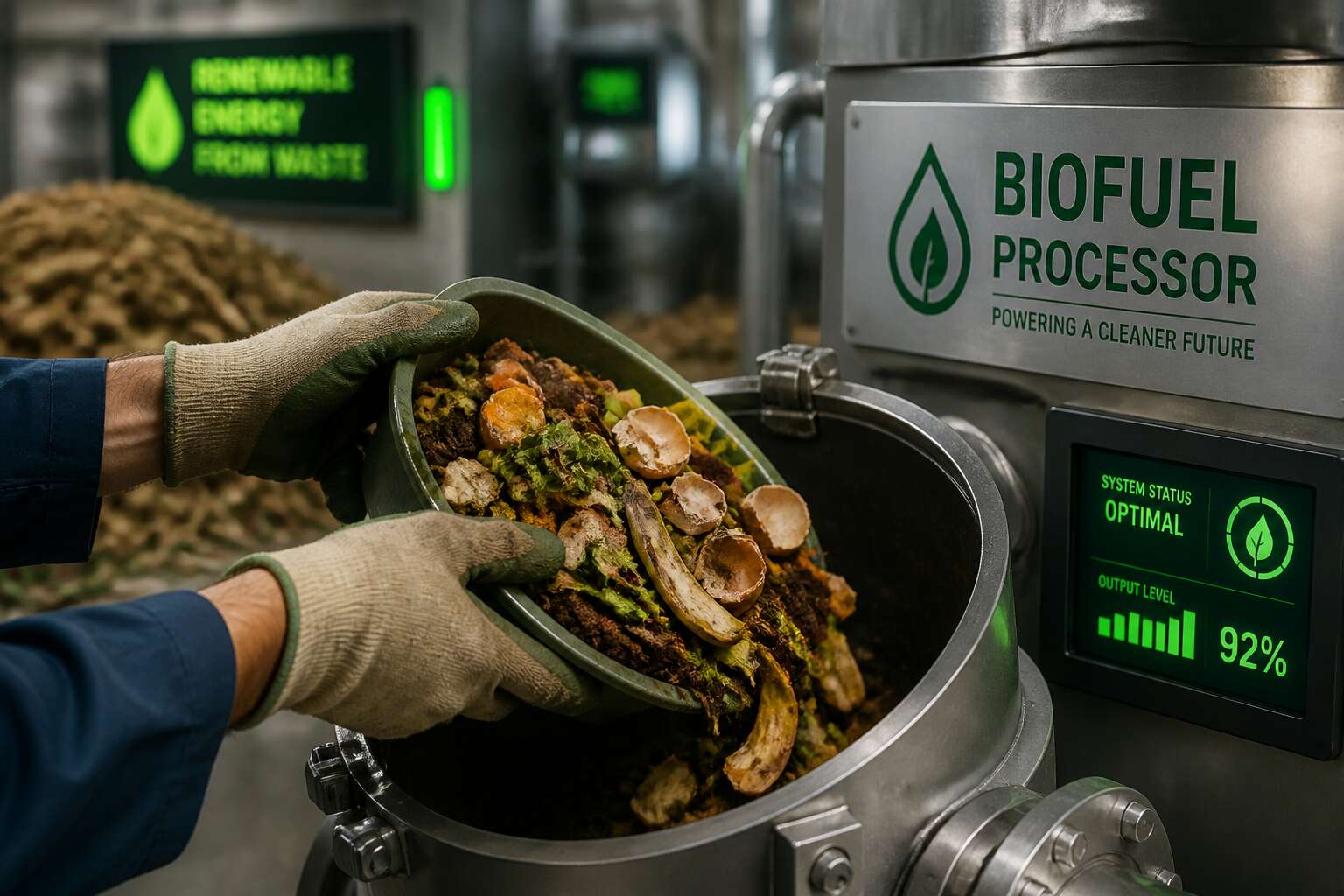
One man’s rubbish is another man’s reserve tank. That phrase captures the essence of waste-derived feedstocks, a cornerstone of the biofuels and waste energy sector. This is not about growing crops; it is about intercepting society’s discarded materials before they reach a landfill. The value lies in the embedded energy within these residues, waiting to be unlocked through conversion technologies.
The classification of these feedstocks is as varied as the waste itself. Municipal solid waste, agricultural residues like maize stalks and sugarcane bagasse, and industrial byproducts such as wood chips and paper mill sludge all fall under this umbrella. The challenge is not scarcity, but logistics. The collection, sorting, and pre-treatment of these heterogeneous materials require robust infrastructure to ensure a consistent supply for conversion plants.
Different streams suit different processes.
1. High-moisture organic waste, like food scraps, is ideal for anaerobic digestion.
2. Dry, lignocellulosic materials, such as timber offcuts, are better suited for thermal conversion.
3. Used cooking oil is a prime candidate for biodiesel production.
Each feedstock demands a specific technological approach to maximise energy yield and minimise contamination.
For South Africa, this represents a dual opportunity. We can simultaneously address the mounting pressure on municipal landfills while creating a decentralised energy source. However, the success of these projects hinges on the economics of collection. A feedstock is only valuable if it can be gathered and processed at a cost that competes with fossil fuels. The true potential of biofuels and waste energy lies in mastering this logistical puzzle, transforming our most problematic materials into a strategic asset.
Thermochemical Conversion Technologies
Gasification
At 1,400 degrees Celsius, gasification converts carbon-rich waste into syngas, a blend of hydrogen and carbon monoxide. This thermochemical process uses partial oxidation, not full combustion, preserving the energy stored in the feedstock. In South Africa, where biomass residues and municipal solid waste pile up, gasification turns a disposal problem into biofuels and waste energy!
The syngas can fire turbines for electricity or undergo catalytic refinement into liquid hydrocarbons. Feedstocks vary widely, from sugarcane bagasse to screened refuse. Each requires drying and sizing before entering the reactor chamber.
A typical reactor sequence follows:
- Drying zone eliminates residual moisture.
- Pyrolysis zone releases volatile compounds.
- Reduction zone reacts char with steam.
The resulting gas composition depends on temperature and residence time. High moisture content drops thermal efficiency, so plant operators must balance feedstock blends.
Pyrolysis
Pyrolysis produces charcoal, a technique humans have used for millennia. The modern version runs at 400 to 600 degrees Celsius in an oxygen-free vessel. Here, cellulose and lignin break down into a liquid bio-oil, a gas rich in carbon monoxide and methane, and a solid char. The absence of oxygen prevents combustion, so energy remains stored in the chemical bonds. This differs from gasification, which uses partial oxidation. Pyrolysis suits damp agricultural residues, dried first to a moisture content below 10%. One reactor feed of eucalyptus branches yields these proportions:
– around 60% bio-oil.
– around 20% synthetic gas.
– 20% biochar.
The synthetic gas sustains the reactor’s own burner. The biochar arrests soil degradation, a real concern across the Karoo. The bio-oil, despite its acidity, burns cleanly in modified boilers. It provides a local, dispatchable input to biofuels and waste energy markets.
Direct Combustion
Combustion is the oldest thermal conversion, and still the most brutal. In a direct combustion unit, biomass is burned with excess air, releasing heat that turns water into steam and spins turbines. South African mills run this way every day, feeding sugarcane bagasse, sawmill offcuts, and even invasive alien plant matter into boilers. The power is immediate, but the price is vigilance.
Moisture is the enemy. Wet feedstock consumes energy just to boil away water, so the economics favour dry material. Emission control requires wet scrubbers and filters, and the ash needs a destination. None of this is glamorous, yet it anchors the commercial reality of biofuels and waste energy.
Typical direct combustion feedstocks include:
- Sugarcane bagasse from mills in KwaZulu-Natal
- Black wattle and pine residues from timber plantations
- Sorted municipal solid waste, densified into refuse-derived fuel
Every load changes the burn profile. Corrosion, slagging, and pollutant levels shift with each delivery. Managing that variation is the real work, and it will not fade into history.
Plasma Arc Gasification
Plasma arc gasification operates at extreme temperatures. Plasma torches superheat feedstock beyond 3,000°C inside a sealed vessel, breaking molecular bonds. Organic material converts into synthesis gas, while inorganic matter melts into vitrified slag. This is a phase change rather than simple combustion.
Consider the practical outputs:
- Syngas for engine generation or chemical production
- Slag repurposed as construction aggregate
- Compact flue gas cleaning requirements
For South African municipalities, the technology offers a compact answer to complex waste streams. It is an emerging arena within biofuels and waste energy, where flexibility matters more than scale. As waste volumes rise, the role of plasma arc gasification within the national energy mix will likely expand.
Biological and Chemical Conversion Routes
Anaerobic Digestion
Methane captured from brewery waste digesters in Cape Town already displaces a measurable share of natural gas imports. Anaerobic digestion is a biological conversion route that relies on microbes to decompose organic matter in sealed tanks. The process runs without oxygen and yields biogas, a clean-burning fuel for engines and boilers.
For municipal authorities, this technology turns sewage sludge and food scraps into a reliable energy source. It slots directly into the broader framework of biofuels and waste energy, reducing landfill methane emissions while generating electricity.
Four stages drive the digestion:
- Hydrolysis breaks down complex polymers.
- Acidogenesis produces volatile fatty acids.
- Acetogenesis creates acetic acid, hydrogen, and carbon dioxide.
- Methanogenesis forms methane.
Each phase depends on balanced pH and temperature. We watch these systems turn putrid waste into steady power, and that makes a tangible difference for South Africa’s grid!
Fermentation
Microbes have brewed ethanol for millennia, yet we are only now directing their metabolic activity toward South Africa’s agricultural residues and organic waste. Fermentation converts sugars into liquid fuel, a crucial component of biofuels and waste energy.
The route begins with pretreatment. Enzymes split cellulose and hemicellulose from crop stalks, husks, and bagasse into simple sugars. Yeast or bacteria then metabolise those sugars inside sealed bioreactors. Temperature, pH, and oxygen levels dictate yield.
Viable feedstocks include:
- Sugarcane bagasse from KwaZulu-Natal mills
- Maize stover from Free State farmlands
- Source-separated food waste from municipal programmes
Each source keeps fermentable carbon out of landfills while producing transport fuel that displaces imported petrol!
Biochemical Methane Potential
More than 70 percent of the organic fraction in South African municipal solid waste still ends up in landfills, where it slowly releases methane into the atmosphere. That same material holds untapped biochemical methane potential. Instead of allowing this gas to escape as an uncontrolled emission, we can capture it as a renewable energy source.
The biochemical methane potential test measures how much gas a specific substrate can yield under controlled conditions. This analysis is crucial for designing efficient digesters and predicting output. For planners in Mpumalanga or the Western Cape, this data transforms waste from a nuisance into a reliable input for biofuels and waste energy systems.
The BMP values vary significantly across common South African feedstocks:
– Fruit and vegetable processing rejects from Gauteng markets, high in moisture and fast to degrade.
– Abattoir paunch waste, which offers a steady, protein-rich feedstock.
– Brewery spent grain from craft producers, abundant and consistent in composition.
This biological route pairs well with chemical conversion methods. Thermal hydrolysis, for example, applies heat and pressure to break down stubborn cell structures before digestion. This step makes the organic matter more accessible to microbes, boosting methane yields and shortening retention times. The result is a system that treats waste and generates power, feeding into the broader landscape of biofuels and waste energy.
Esterification and Transesterification
Esterification and transesterification turn waste oils and fats into biodiesel. These chemical routes convert free fatty acids and triglycerides into usable fuel, bypassing the biological pathways already covered. For South African businesses, this means we can recover value from yellow cooking oil and industrial tallow instead of paying to dispose of them.
Tallow from abattoirs, used cooking oil from Johannesburg restaurants, and acid oils from refining plants all carry energy. Esterification handles high free fatty acid loads, while transesterification processes the main oil fraction. Together they deliver a consistent biodiesel output that feeds directly into the biofuels and waste energy sector.
- Acid-catalysed esterification pre-treats low-grade feedstocks.
- Alkali-catalysed transesterification boosts yield.
- Washing and drying steps ensure fuel purity.
These conversion routes are fast, mature, and modular. A small plant in the Free State can process neighbourhood waste oil and sell the finished fuel locally, strengthening South Africa’s shift toward biofuels and waste energy.
Biorefining Approaches
A biorefinery is a sequence of decisions, not a single machine. For South African feedstocks, biological routes handle the wet, organic fraction first, while chemical routes recover energy from lipids and residues that microbes struggle to digest. This layered approach mirrors how a petrochemical refinery treats crude oil, except the input is municipal sludge, spent grain from local breweries, or abattoir waste.
Consider the practical flow:
- Biological conversion stabilises high-moisture organics and captures biogas.
- Chemical conversion treats the lipid-rich fraction for biodiesel.
- Residual heat from one process pre-warms the next.
Each step narrows what remains for disposal. I find this pairing particularly useful because it matches the complexity of real waste streams. The biorefinery concept ties these steps together, making biofuels and waste energy a coherent system for South African businesses in the biofuels and waste energy sector.
Environmental and Economic Impact
Reduction of Landfill Waste
The Marius van der Merwe landfill outside Pretoria receives over 4,000 tons of waste daily. Each ton of decomposing organic matter releases methane into the air, a gas with a warming potential 28 times greater than carbon dioxide over a century. Diverting this organic fraction toward biofuels and waste energy systems transforms a liability into an asset. Communities near these sites notice the difference, not in abstract metrics, but in the air they breathe and the water that filters through the soil below.
The economic case is equally compelling for municipalities and private operators. Landfill operation costs include leachate management, gas capture, and eventual closure and rehabilitation. Every ton diverted reduces these long-term obligations.
– Avoided landfill operational expenditure
– Reduced carbon tax liabilities
– Revenue from energy sales
– Extended landfill lifespan
– Decreased groundwater monitoring costs
These figures carry real weight in a country where energy prices climb yearly and waste volumes grow steadily. For local farmers, the processed digestate from anaerobic digestion offers a cheaper alternative to synthetic fertilisers. For township entrepreneurs, small-scale waste collection feeding into bioenergy plants creates income where none existed. Reducing landfill waste through biofuels and waste energy is a quiet engine of rural and peri-urban economic resilience, one that saves money, reduces environmental harm, and strengthens local self-sufficiency.
Energy Recovery Efficiency
In a country where coal supplies the majority of electricity, every unit of energy recovered from organic waste carries an environmental weight. The efficiency of that recovery determines how much embedded energy displaces fossil fuels. High-efficiency anaerobic digestion converts volatile solids with minimal losses, while poor management wastes half the potential.
For municipalities, efficiency in biofuels and waste energy translates into direct economics. A high-efficiency plant returns investment through reduced electricity purchases, carbon tax savings, and extended landfill life. But those returns depend on consistent operation.
Efficiency gains show up in three places.
- The share of volatile solids destroyed during digestion.
- The percentage of output energy consumed by the plant itself, known as parasitic load.
- The capacity to use waste heat for drying feedstock or reheating digesters.
When balanced, biofuels and waste energy systems achieve net greenhouse gas reductions greater than the fuel’s emissions, because they avoid uncontrolled methane release.
Carbon Footprint and Life-Cycle Analysis
Every tonne of organic waste processed through biofuels and waste energy tells a different carbon story depending on the baseline. In South Africa, where grid electricity is coal dominant, a life-cycle analysis demands scrutiny of both direct emissions and displaced fossil fuels. A landfill benchmark releases methane for decades; a digester capturing that gas yields immediate atmospheric benefit.
The carbon footprint of these systems is not fixed. It shifts with feedstock transport, digester leakage, and how digestate is managed. When measured under a full life-cycle framework, biofuels and waste energy can achieve net negative emissions, but only if upstream and downstream losses remain low.
Economic impact follows the carbon ledger. South African municipalities face rising electricity tariffs and landfill gate fees. Projects that reduce volatile solids and capture biogas convert a liability into an energy asset, while earning carbon rebates. The accounting must be honest.
- Carbon credits from verified emission reductions.
- Deferred landfill expansion costs.
Without those fiscal signals, these same life-cycle realities determine whether biofuels and waste energy projects qualify for carbon finance, and the environmental gains remain theoretical.
Cost-Benefit and Market Factors
The arithmetic behind biofuels and waste energy rarely matches the sales pitch we hear. Every rand spent on feedstock logistics either returns as biogas or vanishes as landfill gas. South African municipalities now weigh escalating electricity tariffs against the upfront cost of digesters, and that gap narrows every year.
Market factors complicate the picture. Carbon rebates fluctuate with verification standards. Private investors want predictable revenue streams, and digestate sales help close the funding gap for biofuels and waste energy projects. But the real cost benefit shows up on the balance sheet when deferred landfill expansion and avoided methane penalties become visible!
Consider the variables that drive project viability:
- Capital cost per kilowatt of installed capacity
- Escalating landfill gate fees
- Carbon credit pricing under local verification schemes
Emerging Trends and Future Outlook
Advanced Biofuel from Algae
Algae biofuel is crossing a threshold that few early investors expected. In South Africa, where solar radiation is abundant, closed photobioreactors can produce lipid-rich biomass year round. This remains an exciting frontier area within the broader field of biofuels and waste energy, since algae feed on wastewater nutrients and carbon dioxide from industrial processes. The economic case improves as processing costs fall, and recent pilot projects in the Western Cape show consistent yields.
Emerging trends point to modular systems that small municipalities can operate without steep technical training. The near future may also bring:
- saltwater strains that reduce freshwater demand
- mobile harvesting units that skip costly drying stages
These advances matter because they shift algae from an experimental curiosity to a practical energy option. The outlook hinges on whether local policy can support long term investment in cultivation infrastructure.
Integration with Carbon Capture
The global conversation around carbon emissions is shifting from mere reduction to active removal, and this is where the true future of biofuels and waste energy lies. Instead of treating carbon capture as a separate industrial chore, emerging systems are integrating it directly into the biological conversion cycle. Microbes that produce methane or lipid precursors can be fed a steady diet of flue gas, effectively turning a polluting output into a primary input. This creates a powerful circular loop that improves both the environmental and economic viability of the entire facility.
Point source capture in a biogas plant is becoming more efficient, but the next iteration involves direct air capture paired with biological conversion. A facility in the Free State is testing a system where captured CO₂ is bubbled into a specialised reactor. The resulting biomass is then processed for energy, locking the carbon into a solid form rather than releasing it back into the atmosphere. This is not a theoretical prospect; it is a tangible economic model.
For South African operations, this integration offers several distinct advantages:
1. A new revenue stream through carbon credits for verifiable sequestration.
2. Reduced reliance on virgin feedstock supplies, mitigating supply chain volatility.
3. Enhanced methane yield from digesters when the gas stream is optimised.
4. Eligibility for international green financing that prioritises carbon negative projects.
The combination of environmental remediation and energy generation is the key differentiator. As we scale these systems, the waste product of one energy stream becomes the fuel for another. The future landscape will likely feature facilities that are judged not only on their energy output but also on their ability to permanently sequester atmospheric carbon, making the local energy cycle a critical component of the national climate strategy.
Circular Economy Models
Circular economy models are reshaping how South African industries handle residues. The old linear path, where organic waste ends in landfill, is giving way to closed loops where every output feeds a new input. In this landscape, biofuels and waste energy connect sectors, turning one facility’s effluent into another’s feedstock. This shift rewards cooperation, not isolation.
Industrial symbiosis is the operative trend. Facilities in Gauteng and the Western Cape are negotiating waste supply agreements, sharing heat, gas, and digestate as inputs. The future outlook is straightforward: in a circular economy, the facility that treats by-products as internal currency will outcompete the one that pays for disposal. The opportunity lies in designing production lines around the energy content of every residual stream. This is where biofuels and waste energy deliver measurable value beyond electricity generation.
Policy and Regulatory Drivers
South Africa’s regulatory landscape is changing quickly for waste-to-energy operators. The carbon tax, introduced in 2019, increases the cost of landfill disposal, making anaerobic digestion more financially attractive. The Biofuels Regulatory Framework, long awaited, is being revised to accommodate advanced feedstocks. Meanwhile, the REIPPPP programme continues to accept waste-to-energy projects, though bid window delays create uncertainty.
Policy drivers now converge around three demands:
1. Verifiable emissions reductions
2. Local job creation
3. Municipal waste diversion targets
These conditions reward projects that can prove their emissions balance. Regulation alone cannot force cooperation, a lesson we are learning as municipalities in Mpumalanga pilot waste supply agreements with private energy producers, testing whether policy can translate into reliable feedstock streams. The next iteration of regulations will determine whether biofuels and waste energy become a structural feature of South Africa’s grid, or remain a marginal niche.
Scaling up and Infrastructure
By 2035, the grid will need 14 gigawatts of distributed generation. That number requires substations, rail lines, and water rights to align. I have watched municipalities stall on transformer capacity while technology stands ready.
The emerging trend is co-location. A landfill in Durban now pairs anaerobic digestion with a solar canopy. The resulting power enters the same feeder line.
- Dedicated transfer stations for sorted organic waste
- Reverse vending machines that feed directly into bioenergy plants
- Low-pressure gas pipelines connecting farms to industrial hubs
These pieces make biofuels and waste energy a predictable baseload source. The future outlook depends on infrastructure that can adapt to seasonal waste flows.

0 Comments